Converting ml to grams requires the density of the material being measured. Milliliters describe volume, while grams describe mass, so the two units are not automatically equal. The calculation is simple once the correct density is known: multiply the number of milliliters by the substance’s density in grams per milliliter.
Water provides the familiar exception. Because its density is close to 1 g/mL, 100 mL of water weighs approximately 100 grams. The same volume of cooking oil may weigh about 92 grams, while 100 mL of honey can weigh roughly 142 grams.
This difference matters in baking, product formulation, classroom calculations, and any task where weight affects the result. The following formulas, charts, and examples show how to calculate grams for water and other materials without assuming that every milliliter has the same mass.
The Short Answer: Density Determines the Result
Use this foundational equation:
$$\text{Grams} = \text{Milliliters} \times \text{Density in g/mL}$$
- For a substance with a density of 1 g/mL (such as water):
$$100\text{ mL} \times 1\text{ g/mL} = 100\text{ g}$$ - For cooking oil (density $\approx 0.92\text{ g/mL}$):
$$100\text{ mL} \times 0.92\text{ g/mL} = 92\text{ g}$$ - For pure honey (density $\approx 1.42\text{ g/mL}$):
$$100\text{ mL} \times 1.42\text{ g/mL} = 142\text{ g}$$
There is no single answer for a volume such as 100 mL until the substance is identified.
ML to Grams Formula
The relationship comes from the scientific definition of density:
$$\text{Density} = \frac{\text{Mass}}{\text{Volume}}$$
Rearrange that equation to solve for mass:
$$\text{Mass} = \text{Volume} \times \text{Density}$$
When the volume is entered in milliliters and density is entered in grams per milliliter, the calculated mass is automatically expressed in grams.
In standard scientific symbols:
$$m = V \times \rho$$
Where:
- $m$ is mass in grams (g)
- $V$ is volume in milliliters (mL)
- $\rho$ (rho) is density in grams per milliliter (g/mL)
The units also confirm the result:
$$\text{mL} \times \frac{\text{g}}{\text{mL}} = \text{g}$$
The milliliter units cancel out cleanly, leaving grams.
A Simple Three-Step Conversion Method
Follow this consistent process for any liquid, paste, powder, or recipe ingredient:
- Identify the substance
Do not begin with the assumption that it behaves like water. Milk, oil, syrup, alcohol, flour, and cosmetic products all have different densities. - Find its density
Look for a value stated in g/mL. A manufacturer’s technical data sheet is preferable for a commercial product because formulas can differ between brands.
If the density appears in kilograms per liter, the numerical value is the same: $$1\text{ kg/L} = 1\text{ g/mL}$$ A density of 0.92 kg/L can therefore be entered directly as 0.92 g/mL. - Multiply volume by density
Suppose you have 80 mL of a liquid with a density of 1.15 g/mL: $$80 \times 1.15 = 92\text{ g}$$ The 80 mL sample has a mass of 92 grams.
Comparison Chart for Water, Oil, and Honey
This table demonstrates why the ingredient must be known before converting. It uses representative densities of:
- Water: 1.00 g/mL
- Cooking oil: 0.92 g/mL
- Honey: 1.42 g/mL
| Volume | Water (1.00 g/mL) | Cooking Oil (0.92 g/mL) | Honey (1.42 g/mL) |
|---|---|---|---|
| 5 mL | 5 g | 4.6 g | 7.1 g |
| 15 mL | 15 g | 13.8 g | 21.3 g |
| 30 mL | 30 g | 27.6 g | 42.6 g |
| 50 mL | 50 g | 46 g | 71 g |
| 100 mL | 100 g | 92 g | 142 g |
| 125 mL | 125 g | 115 g | 177.5 g |
| 200 mL | 200 g | 184 g | 284 g |
| 250 mL | 250 g | 230 g | 355 g |
| 500 mL | 500 g | 460 g | 710 g |
| 1,000 mL | 1,000 g | 920 g | 1,420 g |
Note: The oil and honey figures are estimates. Different oil varieties and honey harvests may have slightly different densities depending on temperature and moisture.
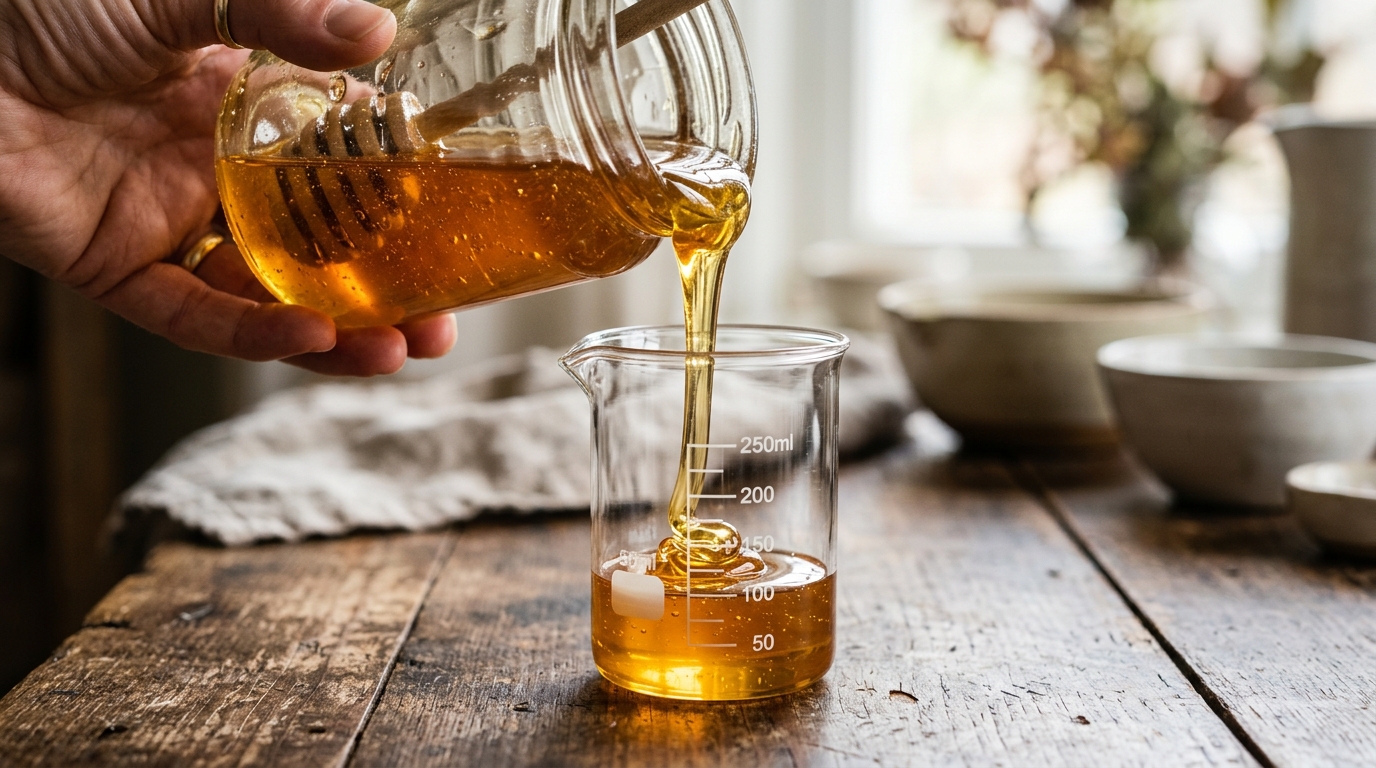
Approximate Densities of Common Liquids
Use this reference table for household, culinary, and general recipe calculations:
| Substance | Approximate Density | Estimated Mass of 100 mL |
|---|---|---|
| Ethanol (Pure Alcohol) | 0.79 g/mL | 79 g |
| Vegetable / Canola Oil | 0.91 to 0.93 g/mL | 91 to 93 g |
| Pure Water (at 4°C) | 1.00 g/mL | 100 g |
| Whole Milk | About 1.03 g/mL | About 103 g |
| Glycerin | About 1.26 g/mL | About 126 g |
| Maple Syrup | About 1.33 g/mL | About 133 g |
| Corn Syrup | About 1.38 g/mL | About 138 g |
| Honey | About 1.40 to 1.44 g/mL | About 140 to 144 g |
Density can change with temperature, concentration, fat content, water content, and added ingredients. Product-specific information should replace a general table when scientific accuracy is required.
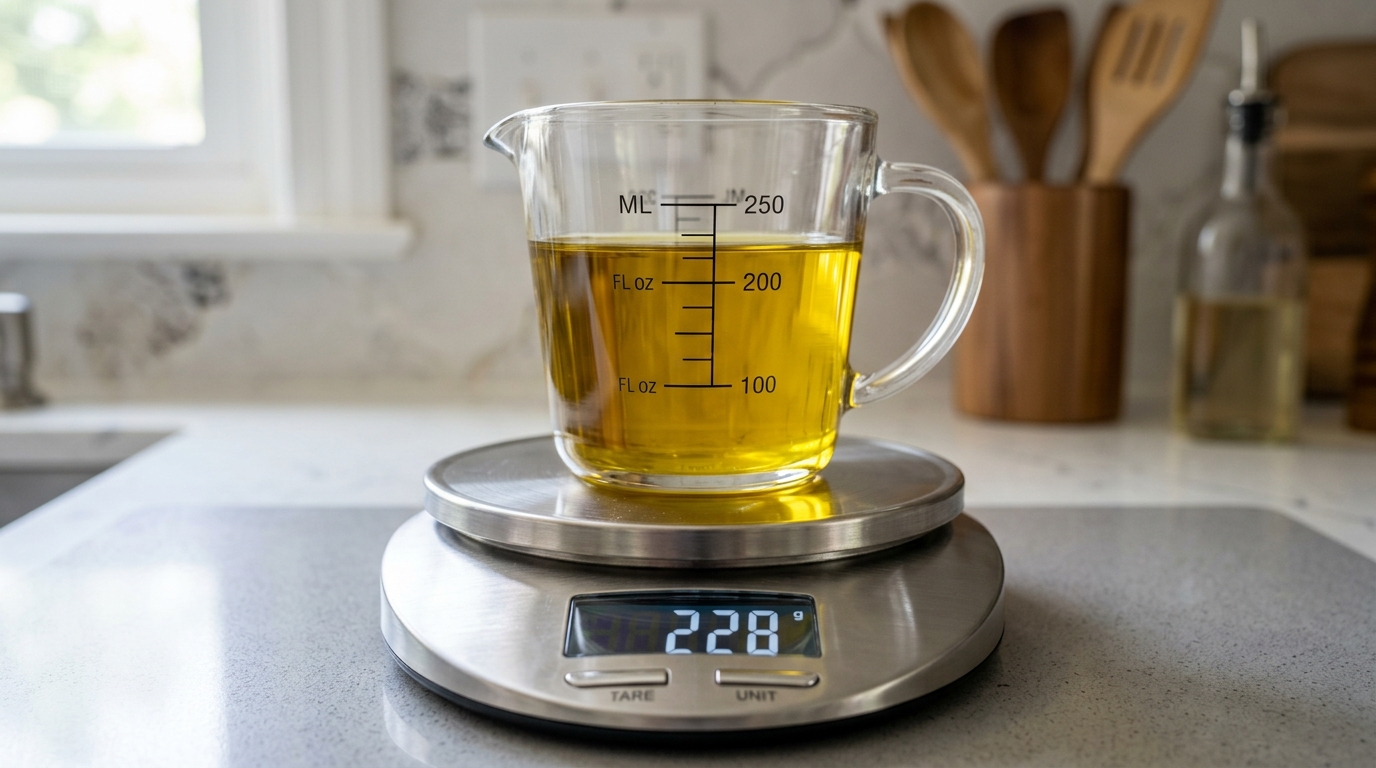
Worked Practical Calculations
Worked Calculation for Milk
Suppose a recipe requires the gram equivalent of 180 mL of whole milk. Use an estimated density of 1.03 g/mL:
$$\text{Grams} = 180\text{ mL} \times 1.03\text{ g/mL} = 185.4\text{ g}$$
Rounding to 185 grams is reasonable for home cooking and baking.
Worked Calculation for Cooking Oil
Convert 60 mL of cooking oil using an estimated density of 0.92 g/mL:
$$\text{Grams} = 60 \times 0.92 = 55.2\text{ g}$$
The oil weighs approximately 55.2 grams. Simply treating 60 mL as 60 grams would overestimate the mass because cooking oil is less dense than water.
Worked Calculation for Honey
Convert 30 mL of honey using an assumed density of 1.42 g/mL:
$$\text{Grams} = 30 \times 1.42 = 42.6\text{ g}$$
The estimated answer is 42.6 grams. Honey is substantially denser than water, so its mass in grams is greater than its numerical volume in milliliters.
Does One Milliliter Equal One Gram?
Only when the material has a density of exactly 1 g/mL.
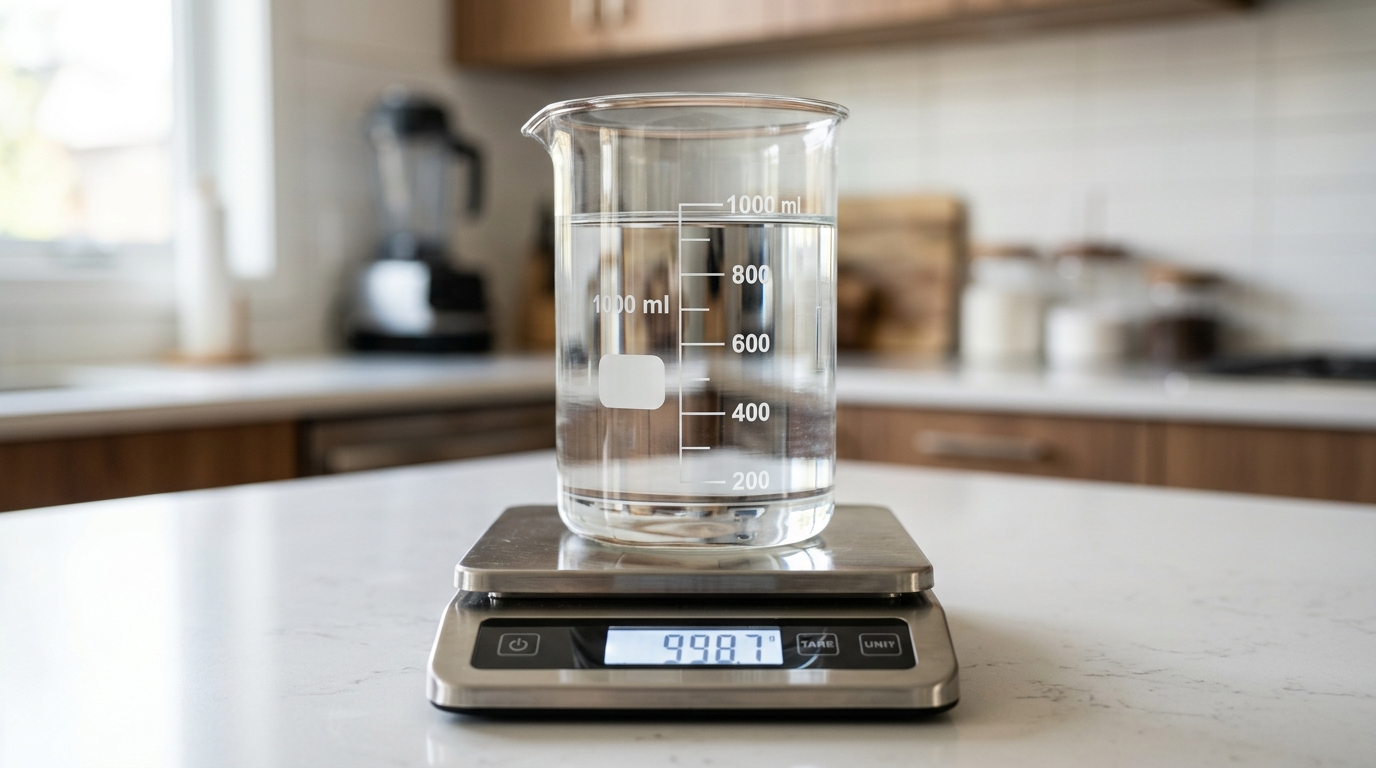
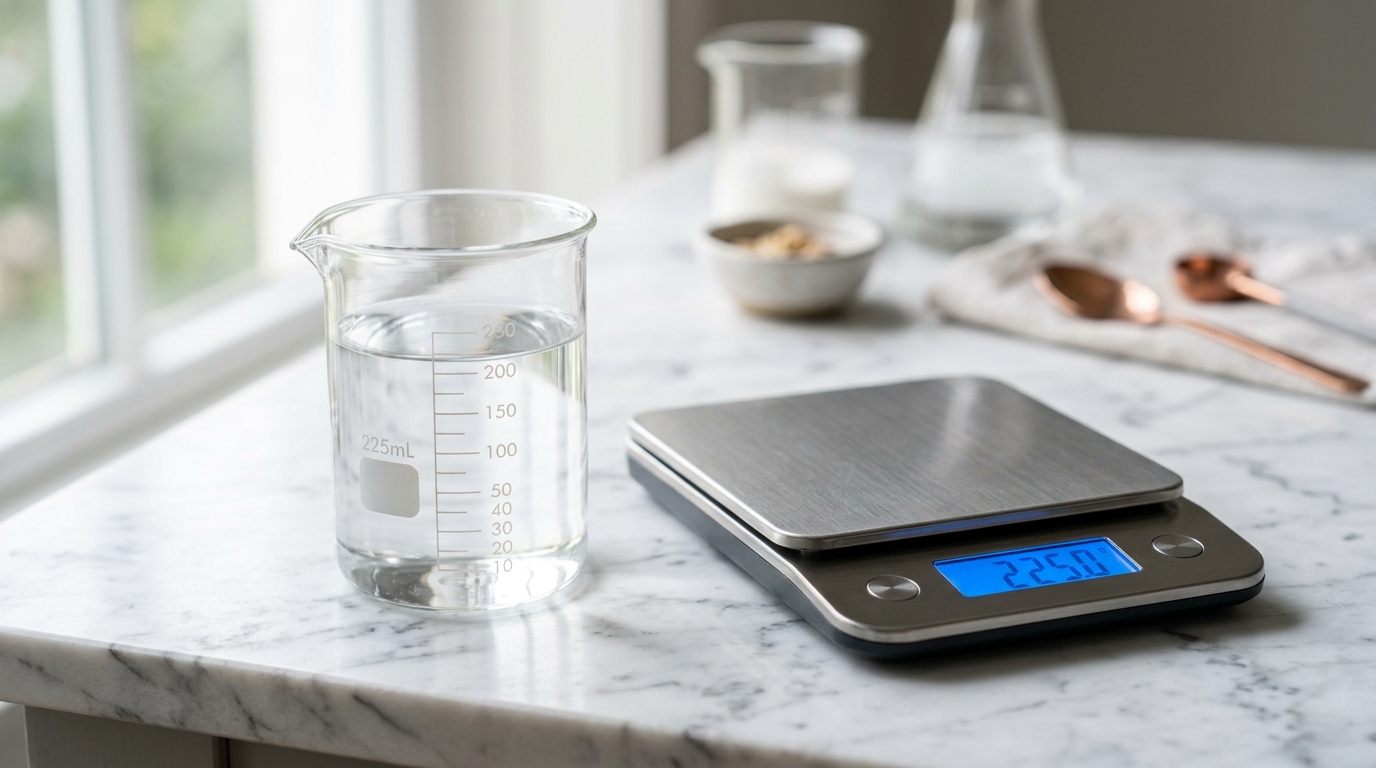
Water is commonly treated as 1 g/mL because its density is very close to that value under ordinary room temperatures:
- 5 mL of water $\approx 5\text{ g}$
- 50 mL of water $\approx 50\text{ g}$
- 250 mL of water $\approx 250\text{ g}$
- 1,000 mL of water $\approx 1,000\text{ g}$ ($1\text{ kg}$)
The symbol ”$\approx$” means approximately equal, not identical under every condition. The rule does not apply to other substances: 1 mL of alcohol weighs less than 1 gram, while 1 mL of glycerin or honey weighs considerably more than 1 gram.
Why Dry Ingredients Are Harder to Convert
A liquid naturally fills its container continuously without internal voids. A powder or granular ingredient contains air spaces between particles, which dramatically changes its bulk density.
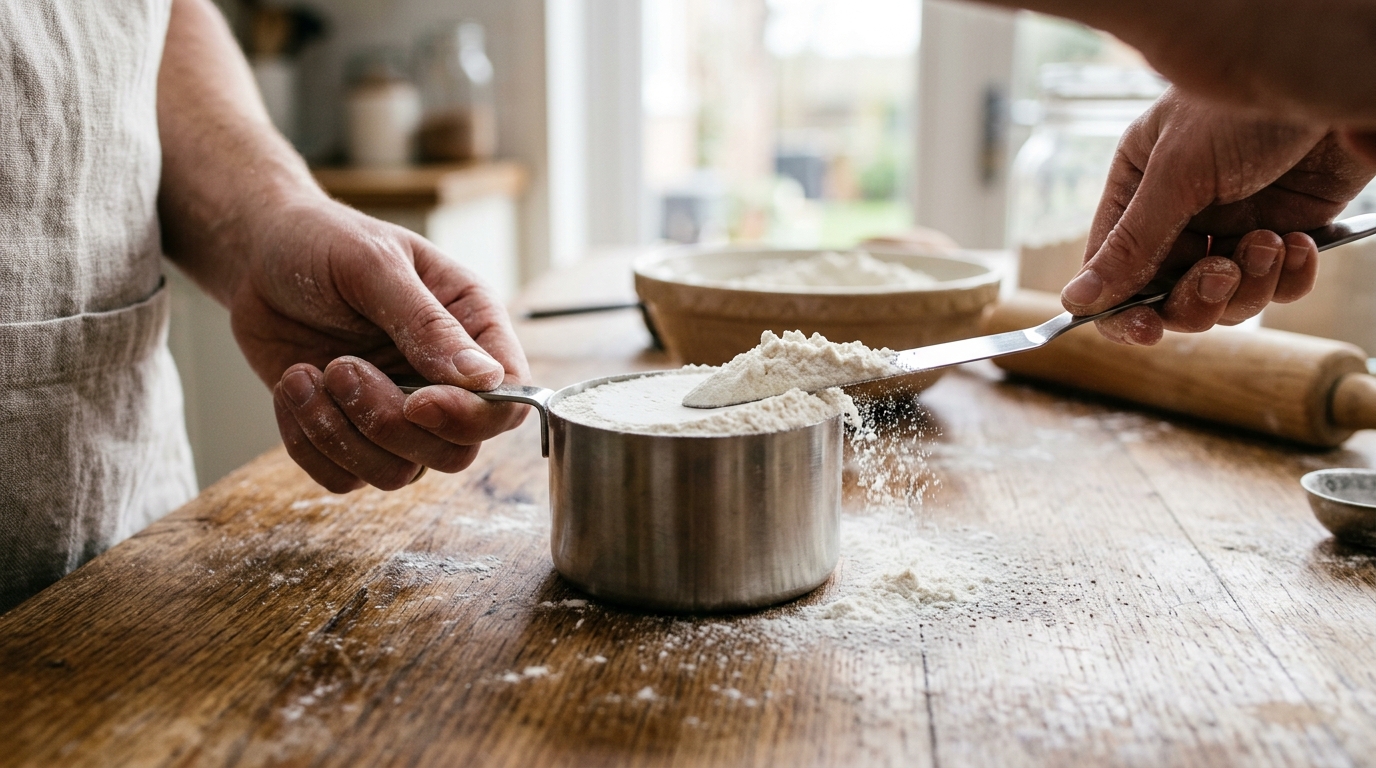
Consider all-purpose flour. The exact same measuring cup can hold very different masses depending on whether the flour is:
- Sifted before measuring
- Spooned lightly into the cup
- Scooped directly from a compacted bag
- Shaken until it settles
- Packed firmly
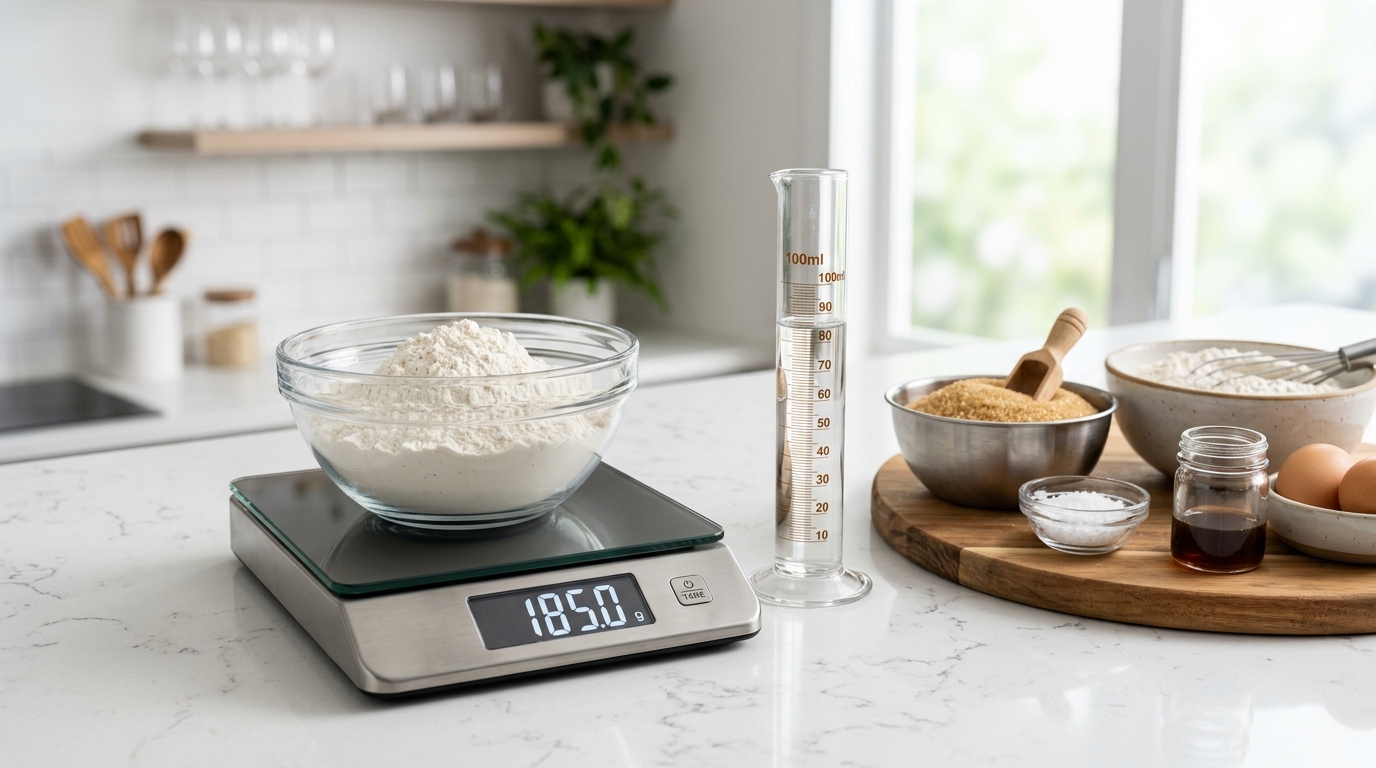
The flour’s chemical substance has not changed, but its air packing has. More particles packed into the same volume produce a higher mass. For this reason, generic milliliter-to-gram values for dry ingredients should be treated as rough estimates. A digital kitchen scale is the gold standard for repeatable baking results.
Converting Grams Back to Milliliters
The formula can be reversed when you know the mass in grams and need to calculate the volume:
$$\text{Milliliters} = \frac{\text{Grams}}{\text{Density in g/mL}}$$
Examples:
- For 230 grams of cooking oil ($\rho = 0.92\text{ g/mL}$):
$$\text{Milliliters} = \frac{230}{0.92} = 250\text{ mL}$$ - For 284 grams of honey ($\rho = 1.42\text{ g/mL}$):
$$\text{Milliliters} = \frac{284}{1.42} = 200\text{ mL}$$
Multiplication converts volume to mass; division converts mass back to volume.
How to Find Density When It Is Not Listed
If you have the product and a digital scale, you can measure its density directly:
- Place an empty graduated container on the scale.
- Press the Tare button so the scale displays zero.
- Measure an exact volume, such as 100 mL.
- Read the mass displayed in grams.
- Divide the grams by the milliliters: $$\text{Density} = \frac{\text{Mass (g)}}{\text{Volume (mL)}}$$
If 100 mL of a liquid weighs 108 grams: $$\text{Density} = \frac{108\text{ g}}{100\text{ mL}} = 1.08\text{ g/mL}$$
You can now use $1.08\text{ g/mL}$ to convert any other volume of this product.
Factors That Change the Calculated Mass
The formula is only as accurate as its inputs. Several real-world factors can alter density:
- Temperature: Most liquids expand as they warm and become denser as they cool.
- Product formulation: Skim milk and whole milk have different fat contents and densities. Concentrates and syrups vary by manufacturer.
- Air bubbles and foam: Aerated or whipped mixtures trap air, occupying volume without adding mass.
- Measurement technique: Read transparent liquids at eye level from the bottom of the meniscus.
- Premature rounding: Retain decimals during intermediate calculations and round only at the final step.
Frequently Asked Questions
How many grams are in 1 mL?
The answer depends entirely on density. One milliliter of water weighs approximately 1 gram. One milliliter of cooking oil weighs about 0.92 grams, while 1 mL of honey weighs roughly 1.42 grams.
How many grams is 100 mL?
For water, 100 mL is approximately 100 grams. For vegetable oil, 100 mL weighs about 92 grams. For whole milk, it is around 103 grams, and for honey, roughly 140 to 144 grams.
Is 250 mL the same as 250 grams?
Only for water and liquids with identical density. For cooking oil, 250 mL is about 230 grams. For honey, 250 mL is approximately 355 grams.
Can I convert mL to grams without density?
Not accurately. You must know the substance’s density, look up an ingredient-specific conversion table, or weigh the item on a scale. Calculators that do not ask for the substance assume the density of water.
What is the difference between mL and grams?
A milliliter measures volume (the amount of three-dimensional space an item occupies), while a gram measures mass (the quantity of matter). Density connects the two.
Are mL and cc the same?
Yes. One milliliter (mL) is exactly equal to one cubic centimeter ($\text{cm}^3$ or cc). A density in $\text{g/cm}^3$ is numerically identical to $\text{g/mL}$.