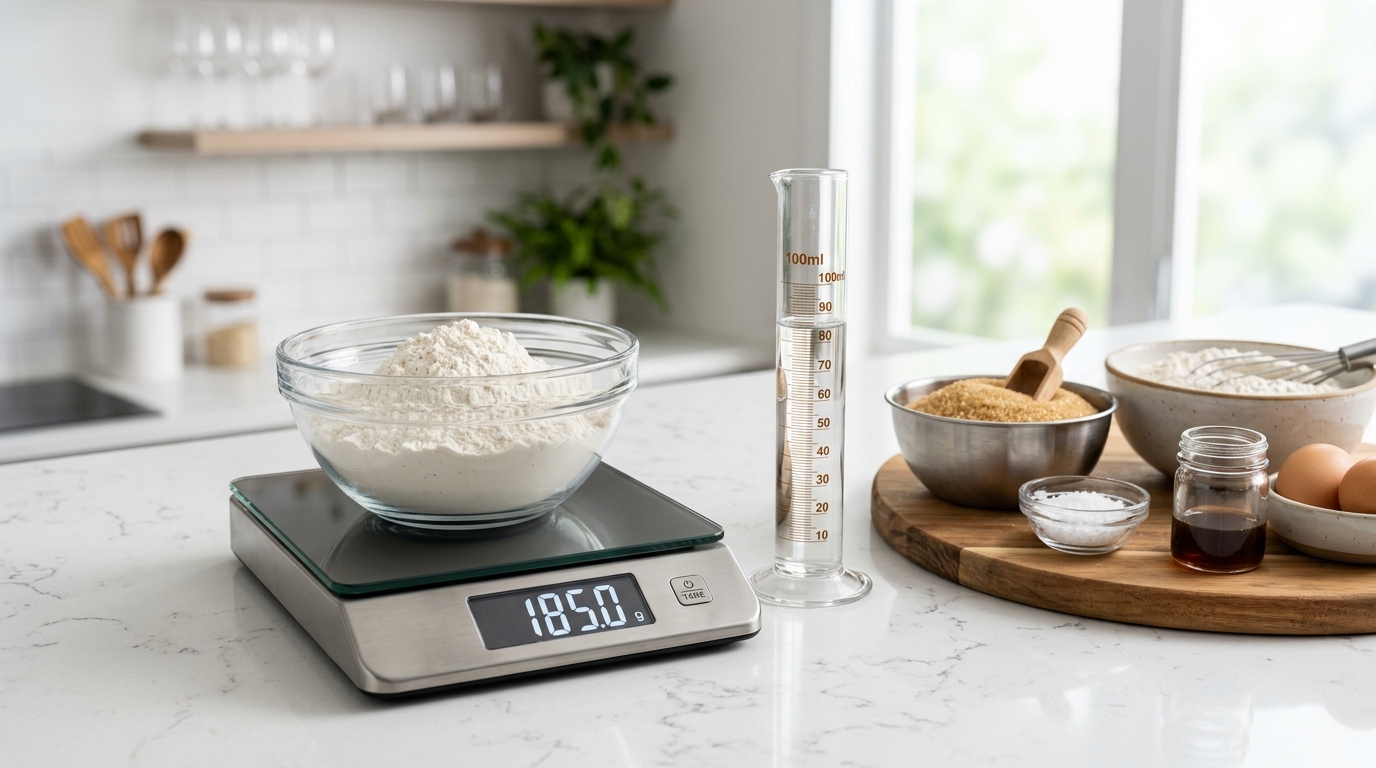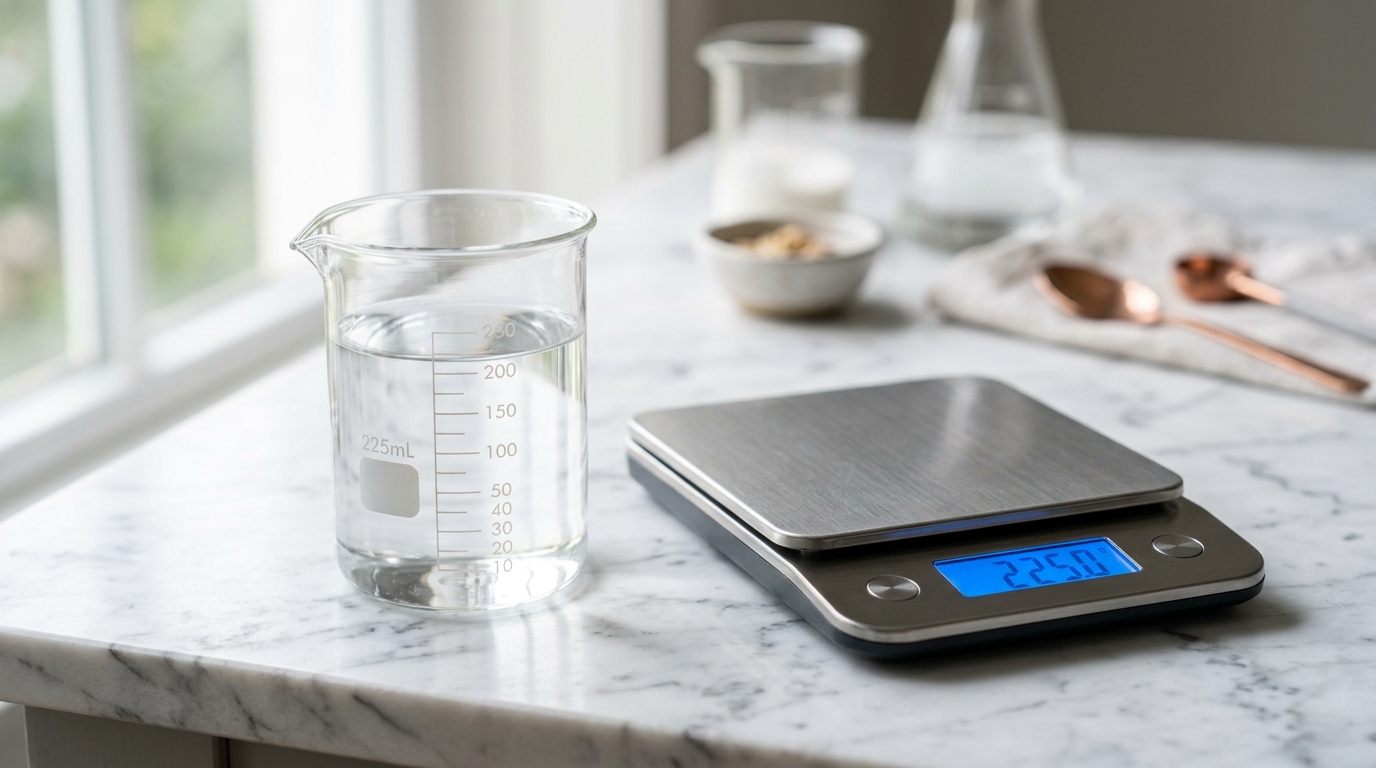
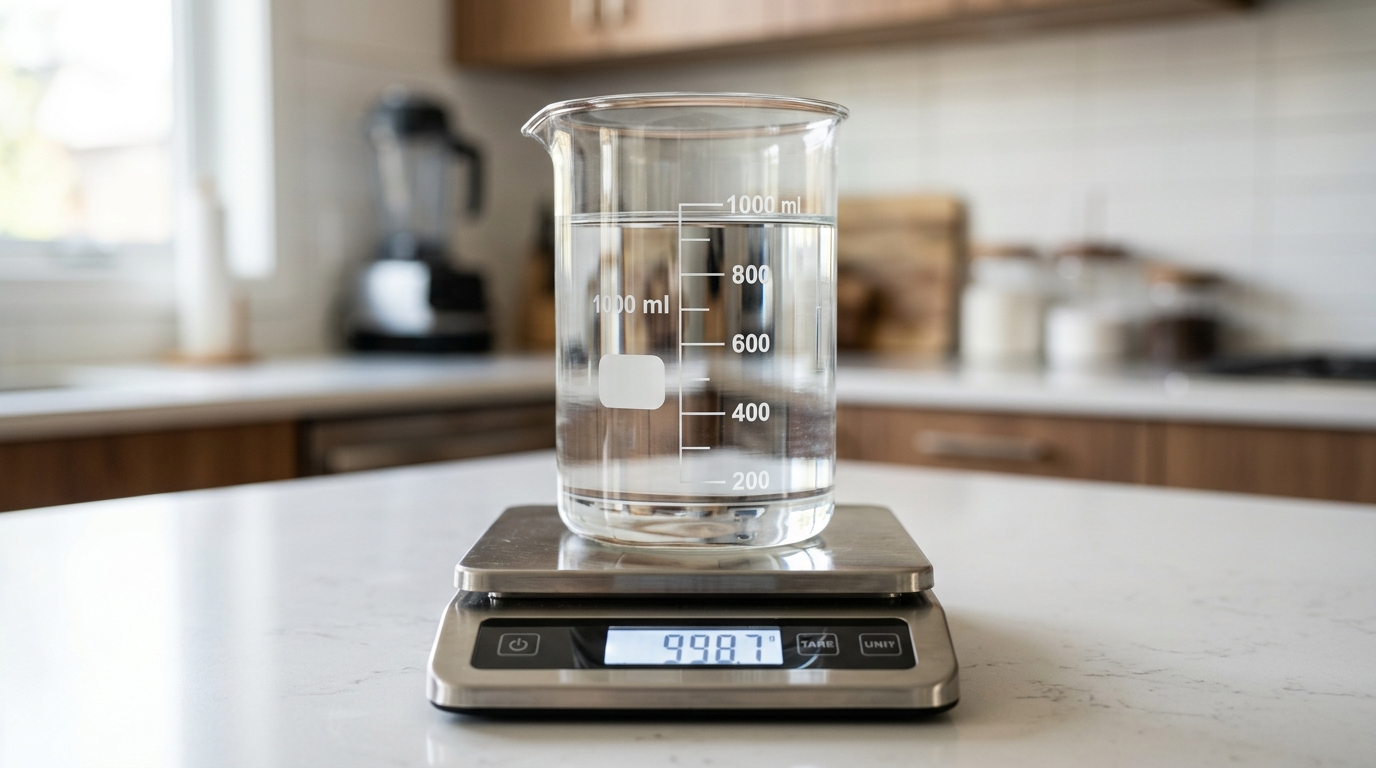
The ml to lbs water conversion is straightforward because one milliliter of pure water weighs approximately one gram under everyday conditions. Using this practical relationship, multiply the number of milliliters by 0.00220462 to calculate the water’s weight in pounds.
For example, 500 mL of water weighs approximately 1.102 pounds, while 1,000 mL (1 liter) weighs about 2.205 pounds. These numbers are accurate for hydration planning, backpacking, recipe scaling, aquarium setups, and postal shipping.
For scientific, brewing, or industrial batch formulation, water temperature and dissolved solids must be considered. At room temperature, water is slightly less dense than at 4°C. This guide provides both the fast everyday shortcut and the high-precision density-based formulas.
Quick Water Conversion Shortcut
Assuming a standard water density of $1\text{ g/mL}$:
$$\text{Pounds of water} = \text{Milliliters} \times 0.00220462$$
Alternatively, divide the milliliters by the number of grams in one pound ($453.59237$):
$$\text{Pounds of water} = \frac{\text{Milliliters}}{453.59237}$$
Common Reference Benchmarks:
- 100 mL of water: $0.220\text{ lb}$ ($3.53\text{ oz}$)
- 250 mL of water: $0.551\text{ lb}$ ($8.82\text{ oz}$)
- 500 mL of water: $1.102\text{ lb}$ ($17.64\text{ oz}$)
- 750 mL of water: $1.653\text{ lb}$ ($26.46\text{ oz}$)
- 1,000 mL (1 L) of water: $2.205\text{ lb}$ ($35.27\text{ oz}$)
- 2,000 mL (2 L) of water: $4.409\text{ lb}$ ($70.55\text{ oz}$)
These values represent the water itself and do not include the container.
The ML to Lbs Water Formula
The full scientific conversion starts with the relationship between mass, volume, and density:
$$\text{Mass} = \text{Volume} \times \text{Density}$$
When volume is measured in milliliters and density in grams per milliliter, the mass is in grams. We then divide by $453.59237$ because one international avoirdupois pound contains exactly $453.59237\text{ grams}$:
$$\text{Pounds} = \frac{\text{mL} \times \text{Water Density (g/mL)}}{453.59237}$$
- Everyday Ambient Formula (using $1.00\text{ g/mL}$):
$$\text{Pounds} = \text{mL} \times 0.00220462$$ - Precision Room Temperature Formula (at 20°C / 68°F, $\rho \approx 0.9982\text{ g/mL}$):
$$\text{Pounds} = \frac{\text{mL} \times 0.9982}{453.59237} = \text{mL} \times 0.00220067$$
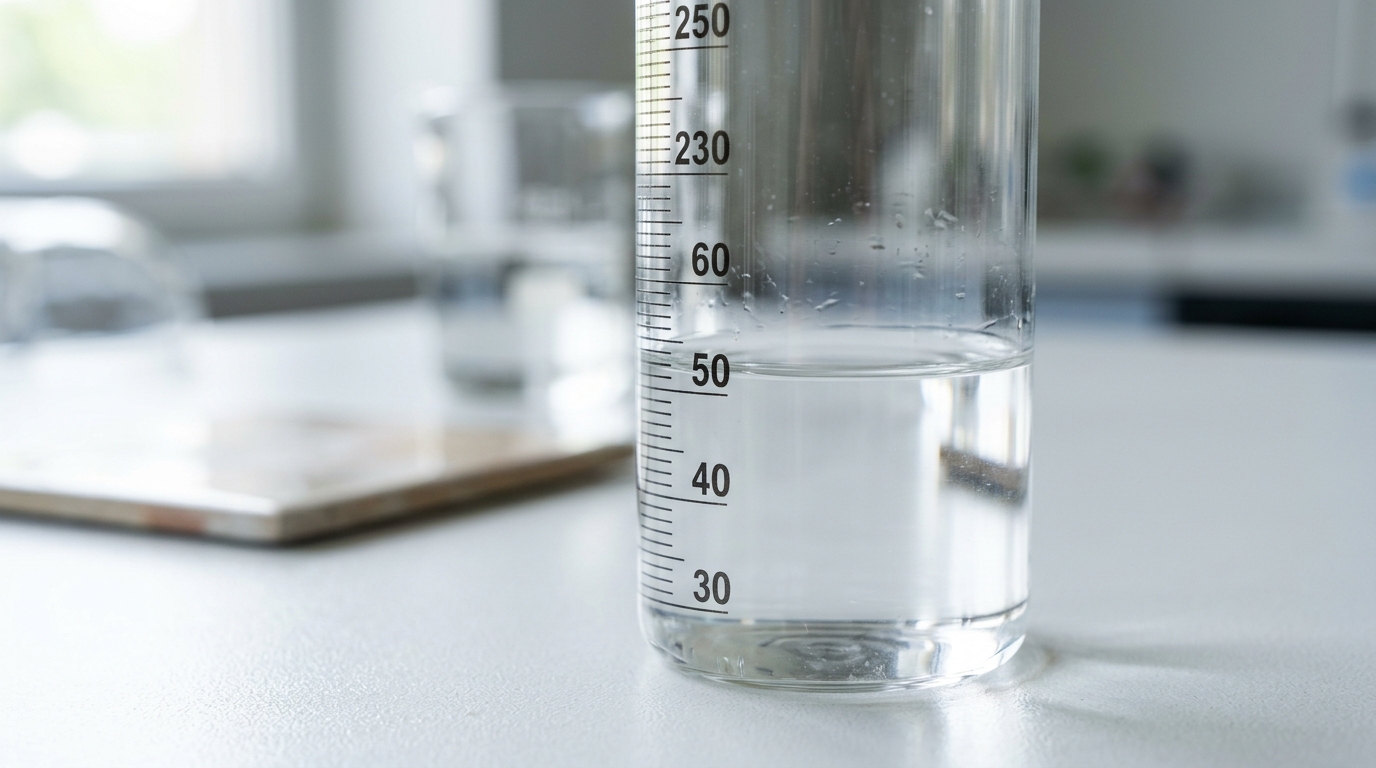
Comprehensive Water Conversion Chart
The following table calculates water weight across common volumes assuming standard density ($1\text{ g/mL}$):
| Water Volume | Equivalent Liters | Weight in Pounds (lb) | Weight in Ounces (oz) |
|---|---|---|---|
| 1 mL | 0.001 L | 0.002 lb | 0.04 oz |
| 5 mL (1 tsp) | 0.005 L | 0.011 lb | 0.18 oz |
| 10 mL | 0.010 L | 0.022 lb | 0.35 oz |
| 25 mL | 0.025 L | 0.055 lb | 0.88 oz |
| 30 mL (1 fl oz) | 0.030 L | 0.066 lb | 1.06 oz |
| 50 mL | 0.050 L | 0.110 lb | 1.76 oz |
| 100 mL | 0.100 L | 0.220 lb | 3.53 oz |
| 125 mL | 0.125 L | 0.276 lb | 4.41 oz |
| 200 mL | 0.200 L | 0.441 lb | 7.05 oz |
| 250 mL (1 Cup) | 0.250 L | 0.551 lb | 8.82 oz |
| 300 mL | 0.300 L | 0.661 lb | 10.58 oz |
| 400 mL | 0.400 L | 0.882 lb | 14.11 oz |
| 500 mL (0.5 L) | 0.500 L | 1.102 lb | 17.64 oz |
| 750 mL (Wine bottle) | 0.750 L | 1.653 lb | 26.46 oz |
| 1,000 mL (1.0 L) | 1.000 L | 2.205 lb | 35.27 oz |
| 1,500 mL (1.5 L) | 1.500 L | 3.307 lb | 52.91 oz |
| 2,000 mL (2.0 L) | 2.000 L | 4.409 lb | 70.55 oz |
| 2,500 mL | 2.500 L | 5.512 lb | 88.18 oz |
| 3,000 mL | 3.000 L | 6.614 lb | 105.82 oz |
| 3,785.41 mL (1 US Gal) | 3.785 L | 8.345 lb | 133.53 oz |
| 5,000 mL (5.0 L) | 5.000 L | 11.023 lb | 176.37 oz |
| 10,000 mL (10.0 L) | 10.000 L | 22.046 lb | 352.74 oz |
Why the One-Gram Shortcut Works
The metric system was originally conceived around water. One cubic centimeter ($\text{cm}^3$ or mL) of pure water at its freezing point was defined as one gram.
That gives rise to convenient relationships:
- $1\text{ mL of water} \approx 1\text{ gram}$
- $1,000\text{ mL of water} \approx 1,000\text{ grams} = 1\text{ kilogram}$
- $1\text{ kilogram} \approx 2.20462\text{ pounds}$
Therefore, one liter of water weighs approximately 2.205 pounds.
Remember that this shortcut is unique to water. Oils, alcohols, syrups, sauces, and milk have different chemical makeups and do not weigh 1 gram per milliliter.
Worked Conversion Examples
Example 1: Convert 250 mL of Water to Pounds
Using the $1\text{ g/mL}$ assumption: $$250\text{ mL} \times 1\text{ g/mL} = 250\text{ grams}$$ Convert grams to pounds: $$\frac{250}{453.59237} = 0.55116\text{ lb}$$ Expressed in ounces: $$0.55116 \times 16 = 8.82\text{ oz}$$ Result: 250 mL of water weighs 0.551 lb or 8.82 oz.
Example 2: Convert 1,200 mL of Water to Pounds and Ounces
$$1,200\text{ mL} \approx 1,200\text{ grams}$$ $$\frac{1,200}{453.59237} = 2.64555\text{ lb}$$ To separate into whole pounds and remaining ounces:
- Whole pounds: 2 lb
- Decimal remainder: $0.64555 \times 16 = 10.33\text{ oz}$ Result: 1,200 mL of water weighs 2 lb 10.33 oz.
Example 3: How Many Milliliters of Water Equal One Pound?
Reversing the calculation: $$\text{Milliliters} = 453.59237\text{ grams} \div 1\text{ g/mL} = 453.59\text{ mL}$$ About 454 mL of water weighs exactly one pound. Since a US liquid pint contains about 473 mL, a pint of water weighs roughly 1.04 pounds (just over 16.6 oz).
How Temperature Changes Water Density
Water expands when heated and contracts when cooled until it reaches maximum density at 3.98°C (39.2°F).
| Water Temperature | Water Density | Mass of 1,000 mL (lb) |
|---|---|---|
| 4°C / 39.2°F (Peak) | 1.0000 g/mL | 2.2046 lb |
| 10°C / 50°F | 0.9997 g/mL | 2.2040 lb |
| 20°C / 68°F (Room temp) | 0.9982 g/mL | 2.2006 lb |
| 25°C / 77°F | 0.9970 g/mL | 2.1980 lb |
| 40°C / 104°F | 0.9922 g/mL | 2.1874 lb |
| 60°C / 140°F | 0.9832 g/mL | 2.1676 lb |
| 80°C / 176°F | 0.9718 g/mL | 2.1425 lb |
| Near 100°C / 212°F (Boiling) | 0.9584 g/mL | 2.1129 lb |
At room temperature (20°C), 1,000 mL of water weighs $2.2006\text{ lb}$ instead of $2.2046\text{ lb}$—a difference of just $0.004\text{ lb}$ (0.06 oz).
Practical Applications
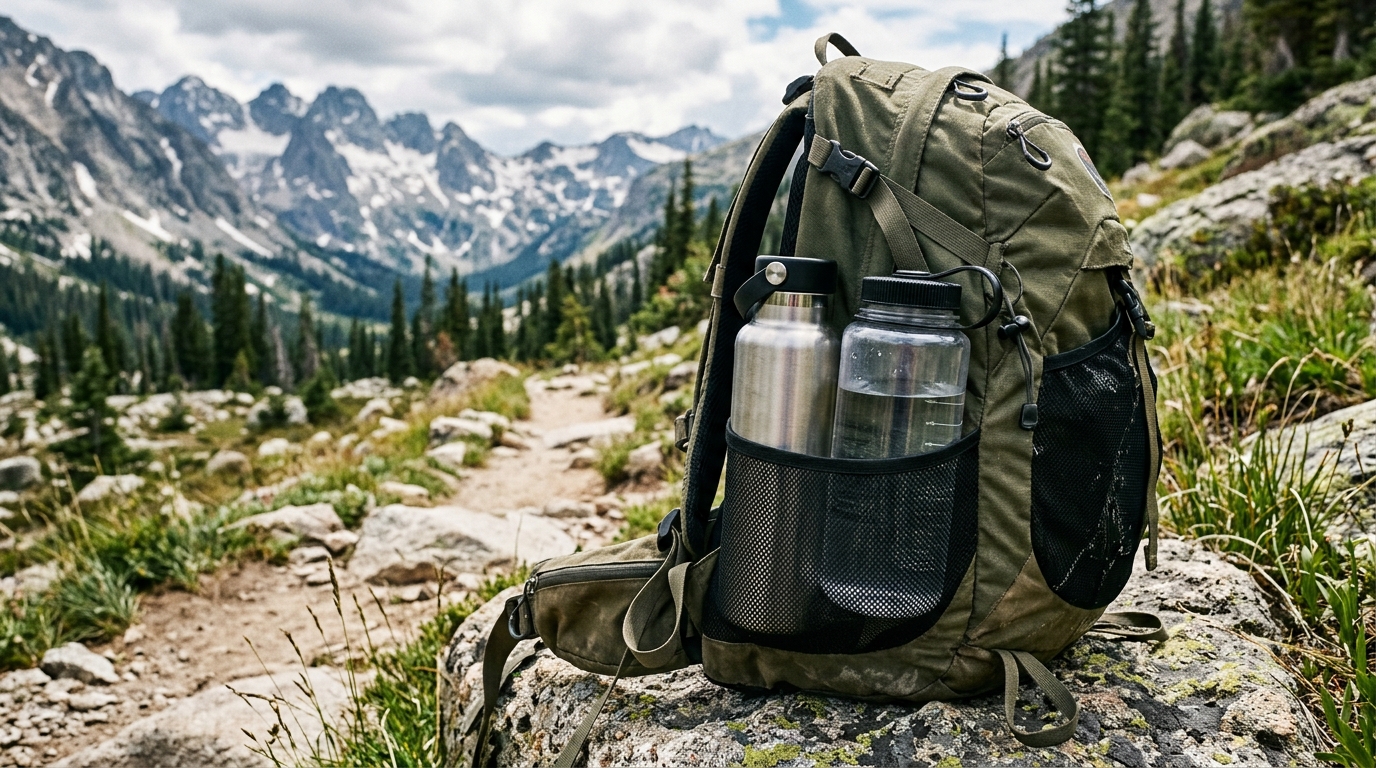
- Hiking & Backpacking: Water is often the heaviest item in a hiker’s pack. A 3-liter hydration reservoir adds 6.6 pounds of water plus the pack bladder.
- Aquarium Load Engineering: Aquarists must calculate water weight accurately to verify that flooring and stands can support the volume. A 200-liter (200,000 mL) tank holds 441 pounds of water alone.

- Culinary Precision: When following European or international pastry recipes written in metric milliliters, measuring water on a gram scale is faster and cleaner than washing measuring jugs.
Frequently Asked Questions
How many pounds does 100 mL of water weigh?
Using standard density, 100 mL of water weighs 0.2205 pounds (approximately 3.53 oz).
How many pounds is 500 mL of water?
Five hundred milliliters of water weighs 1.102 pounds (1 lb 1.64 oz).
How much does 1,000 mL of water weigh?
One thousand milliliters (1 liter) of water weighs 2.2046 pounds (35.27 oz).
How many milliliters of water make one pound?
Approximately 453.6 mL of water weighs exactly one pound.
Is hot water lighter than cold water?
A given volume of hot water weighs slightly less than the same volume of cold water because water expands when heated. For example, 1,000 mL of boiling water weighs about 2.11 pounds, while 1,000 mL of near-freezing water weighs 2.205 pounds.