Converting ml to lbs and oz requires more than a single conversion factor. A milliliter measures volume (space occupied), while pounds and ounces measure mass. You must know the density of the substance before you can calculate its weight accurately.
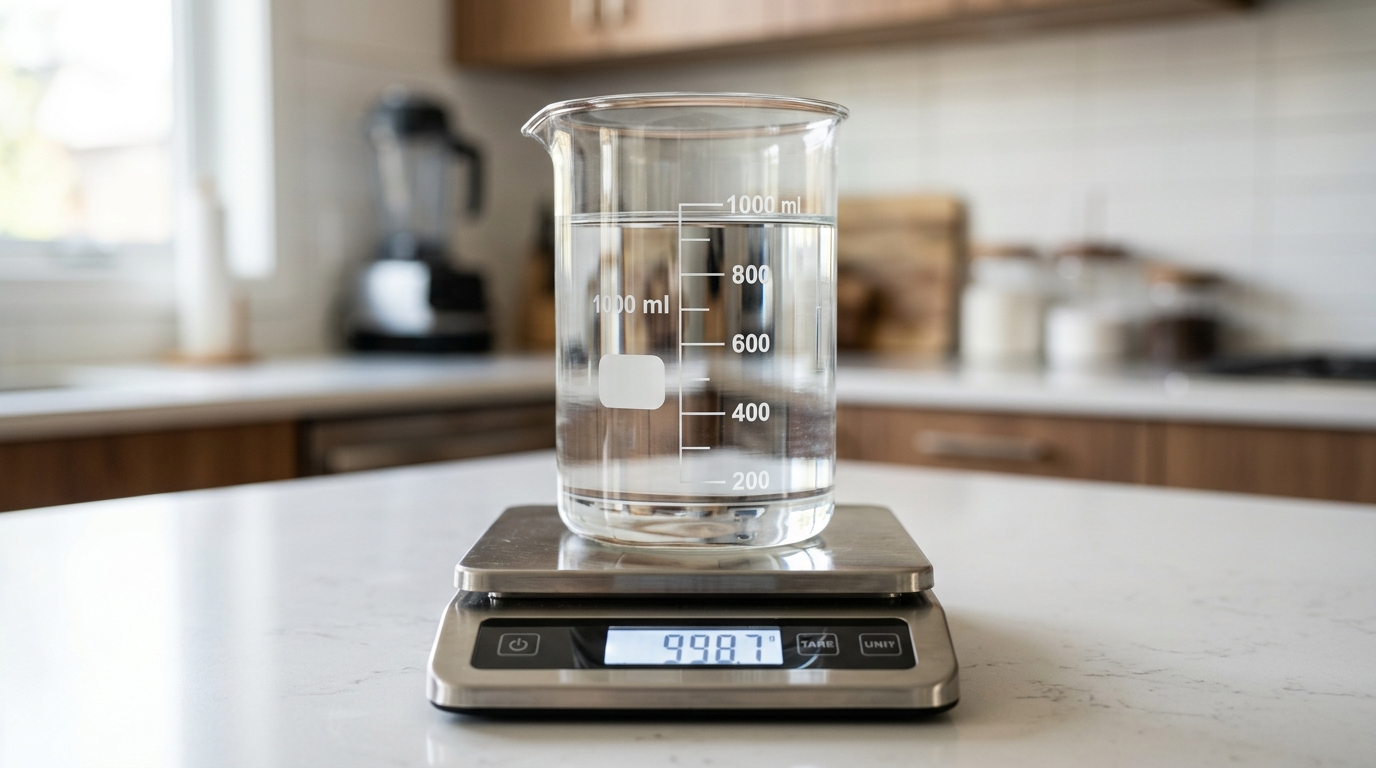
For water, the conversion is straightforward because water has a density close to $1\text{ g/mL}$ under ordinary conditions. Therefore, 500 mL of water weighs approximately 500 grams, which equals about 1.10 pounds or 1 pound 1.64 ounces. The same 500 mL of cooking oil, milk, or honey will have a noticeably different weight because each substance has a distinct density.
This guide explains the step-by-step formula, provides a comprehensive water conversion chart, shows how to express answers in combined pounds and ounces, and clears up the common confusion between fluid ounces and ounces by weight.
Quick Answer Formulas
To convert milliliters to pounds and ounces, multiply the volume by the substance’s density in grams per milliliter ($\text{g/mL}$) to find mass in grams, then convert grams into pounds or ounces:
$$\text{Pounds} = \frac{\text{mL} \times \text{Density (g/mL)}}{453.59237}$$
$$\text{Ounces} = \frac{\text{mL} \times \text{Density (g/mL)}}{28.349523125}$$
For Water (Assumed Density $\approx 1.00\text{ g/mL}$):
- 1 mL: $\approx 0.002205\text{ lb}$ ($0.03527\text{ oz}$)
- 100 mL: $\approx 0.220\text{ lb}$ ($3.53\text{ oz}$)
- 500 mL: $\approx 1.102\text{ lb}$ ($1\text{ lb } 1.64\text{ oz}$)
- 1,000 mL: $\approx 2.205\text{ lb}$ ($2\text{ lb } 3.27\text{ oz}$)
Why Milliliters Cannot Convert Directly to Pounds
Milliliters and pounds measure different physical properties:
- A milliliter (mL) measures volume—the three-dimensional space an ingredient fills.
- A pound (lb) and ounce (oz) measure mass—the actual quantity of matter. One international avoirdupois pound equals exactly $453.59237\text{ grams}$, and one pound contains 16 avoirdupois ounces ($1\text{ oz} = 28.349523125\text{ g}$).
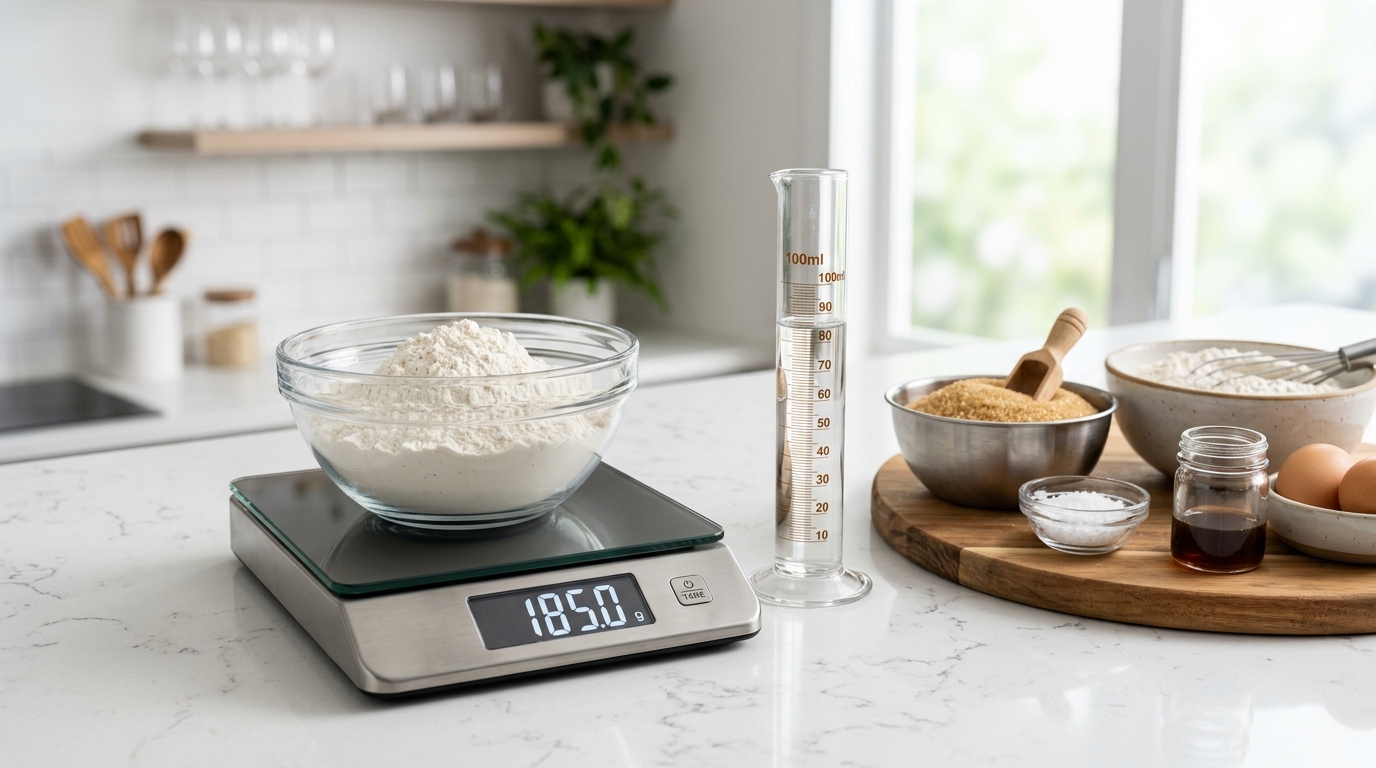
Volume alone does not reveal mass. Imagine two identical 500 mL glass jars: one filled with cooking oil and the other with honey. Both take up the exact same amount of space, but the honey is far heavier because of its higher density.
A correct conversion always requires two values:
- The volume in milliliters (mL)
- The density of the substance in grams per milliliter (g/mL)
The 3-Step ML to Lbs and Oz Formula
Step 1: Find Mass in Grams
$$\text{Mass in grams} = \text{Volume in mL} \times \text{Density in g/mL}$$ Example: 300 mL of a liquid with density $1.2\text{ g/mL}$: $$300 \times 1.2 = 360\text{ grams}$$
Step 2: Convert Grams to Decimal Pounds
$$\text{Pounds} = \frac{\text{Grams}}{453.59237}$$ $$\frac{360}{453.59237} = 0.7937\text{ lb} \approx 0.79\text{ lb}$$
Step 3: Convert Grams to Ounces
$$\text{Ounces} = \frac{\text{Grams}}{28.349523125}$$ $$\frac{360}{28.349523125} = 12.6986\text{ oz} \approx 12.70\text{ oz}$$
Both answers represent the exact same mass: $0.79\text{ lb}$ or $12.70\text{ oz}$.
How to Express the Answer in Combined Pounds and Ounces
A decimal pound value is not the same as a result written in pounds and ounces. For instance, $2.5\text{ pounds}$ means $2\text{ pounds and } 8\text{ ounces}$, not 2 pounds and 5 ounces!
The Simple Method:
- Take the total ounces (e.g., $35.274\text{ oz}$).
- Divide by 16: $$\frac{35.274}{16} = 2\text{ with a remainder of } 3.274\text{ oz}$$
- Express as: $2\text{ lb } 3.27\text{ oz}$.
Starting from Decimal Pounds:
For $2.2046\text{ pounds}$:
- Whole number portion = $2\text{ lb}$
- Decimal portion = $0.2046 \times 16 = 3.2736\text{ oz}$
- Combined result = $2\text{ lb } 3.27\text{ oz}$
Milliliters to Pounds and Ounces Chart for Water
This chart assumes water has a density of $1.00\text{ g/mL}$:
| Water Volume | Mass in Grams | Decimal Pounds | Total Ounces | Combined Pounds & Ounces |
|---|---|---|---|---|
| 50 mL | 50 g | 0.110 lb | 1.76 oz | 0 lb 1.76 oz |
| 100 mL | 100 g | 0.220 lb | 3.53 oz | 0 lb 3.53 oz |
| 150 mL | 150 g | 0.331 lb | 5.29 oz | 0 lb 5.29 oz |
| 200 mL | 200 g | 0.441 lb | 7.05 oz | 0 lb 7.05 oz |
| 250 mL | 250 g | 0.551 lb | 8.82 oz | 0 lb 8.82 oz |
| 300 mL | 300 g | 0.661 lb | 10.58 oz | 0 lb 10.58 oz |
| 400 mL | 400 g | 0.882 lb | 14.11 oz | 0 lb 14.11 oz |
| 500 mL | 500 g | 1.102 lb | 17.64 oz | 1 lb 1.64 oz |
| 600 mL | 600 g | 1.323 lb | 21.16 oz | 1 lb 5.16 oz |
| 750 mL | 750 g | 1.653 lb | 26.46 oz | 1 lb 10.46 oz |
| 1,000 mL | 1,000 g | 2.205 lb | 35.27 oz | 2 lb 3.27 oz |
| 1,500 mL | 1,500 g | 3.307 lb | 52.91 oz | 3 lb 4.91 oz |
| 2,000 mL | 2,000 g | 4.409 lb | 70.55 oz | 4 lb 6.55 oz |
Worked Examples for Common Liquids
Worked Example 1: 500 mL of Water
- Density $= 1.00\text{ g/mL}$
- Mass $= 500\text{ g}$
- Pounds: $500 \div 453.59237 = 1.1023\text{ lb}$
- Total ounces: $500 \div 28.349523125 = 17.637\text{ oz}$
- Subtract 16 ounces ($1\text{ lb}$): $17.637 - 16 = 1.64\text{ oz}$
- Result: 1 lb 1.64 oz
Worked Example 2: 750 mL of Cooking Oil
Cooking oil is lighter than water, with an estimated density of $0.92\text{ g/mL}$.
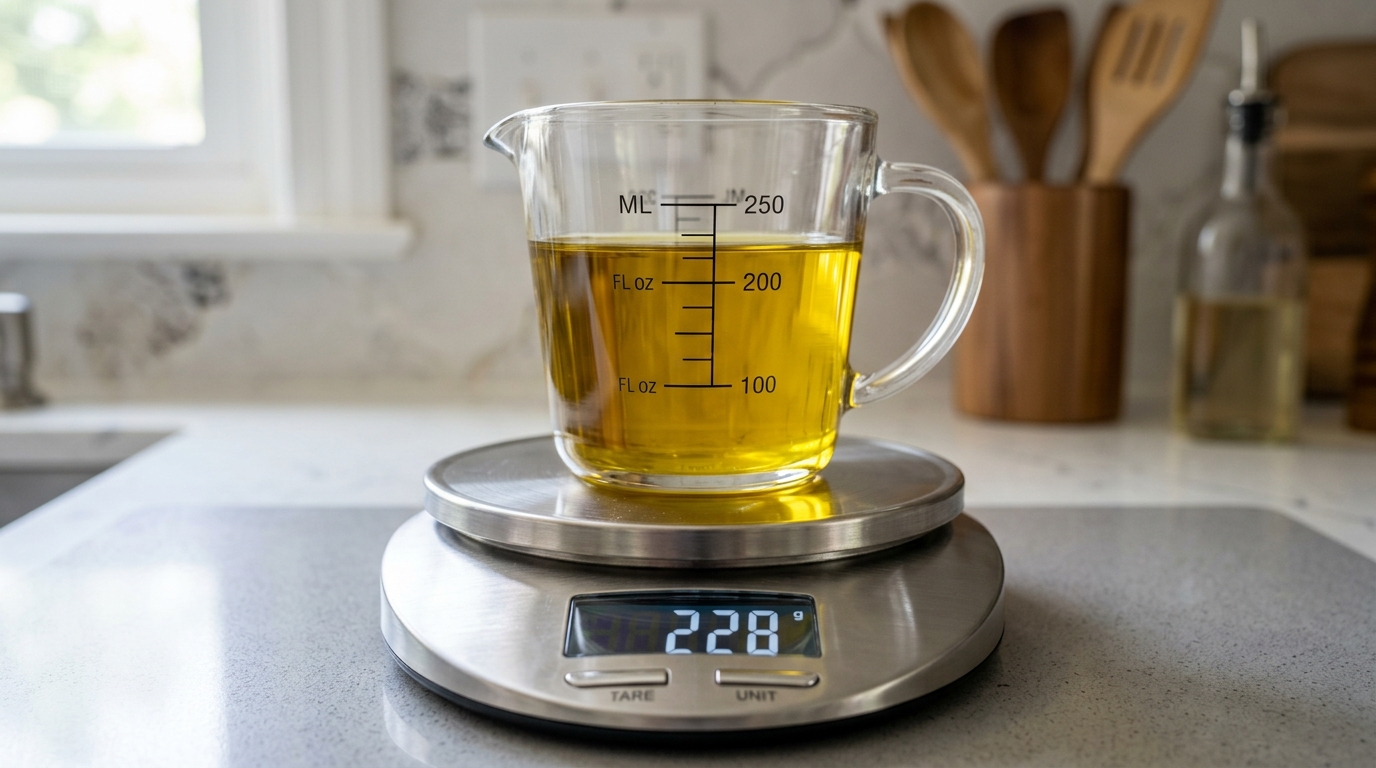
- Calculate mass: $750 \times 0.92 = 690\text{ grams}$
- Total ounces: $690 \div 28.349523125 = 24.339\text{ oz}$
- Separate pounds and ounces: $24.339 - 16 = 8.339\text{ oz}$
- Result: 1 lb 8.34 oz
(Notice that 750 mL of water weighs 1 lb 10.46 oz, while the same volume of oil weighs 1 lb 8.34 oz).
Worked Example 3: 250 mL of Honey
Honey is a dense syrup with an average density of $1.42\text{ g/mL}$.
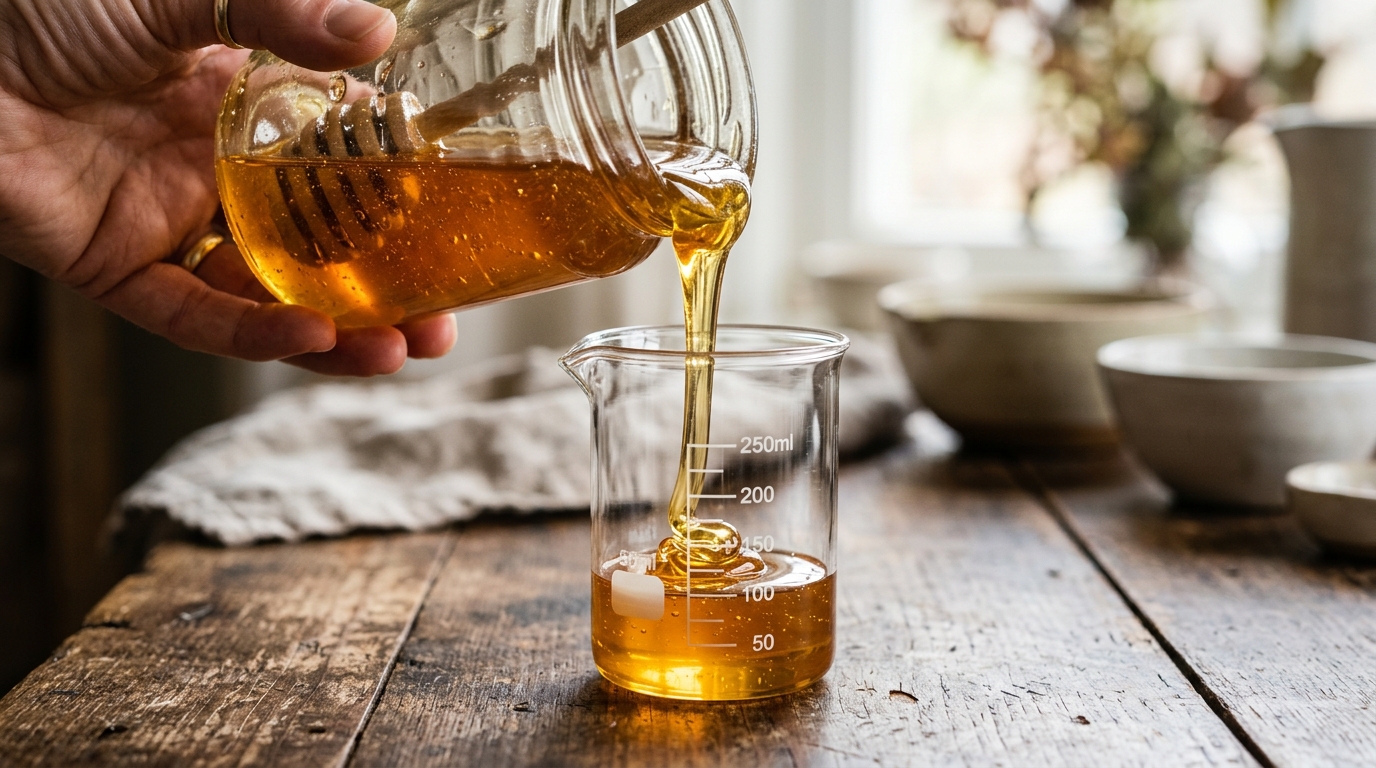
- Mass: $250 \times 1.42 = 355\text{ grams}$
- Decimal pounds: $355 \div 453.59237 = 0.7826\text{ lb}$
- Total ounces: $355 \div 28.349523125 = 12.522\text{ oz}$
- Result: 0 lb 12.52 oz (or 0.78 lb)
Approximate Density Table for Common Liquids
| Substance | Approximate Density | Estimated Weight of 500 mL |
|---|---|---|
| Cooking Oil | 0.91 to 0.93 g/mL | 1.00 to 1.03 lb (16.0 to 16.5 oz) |
| Pure Water | ~1.00 g/mL | 1.10 lb (17.6 oz / 1 lb 1.6 oz) |
| Whole Milk | ~1.03 g/mL | 1.14 lb (18.2 oz / 1 lb 2.2 oz) |
| Light Corn Syrup | ~1.33 g/mL | 1.47 lb (23.5 oz / 1 lb 7.5 oz) |
| Honey | 1.40 to 1.44 g/mL | 1.54 to 1.59 lb (24.7 to 25.4 oz) |
Ounces by Weight vs. Fluid Ounces
A weight ounce and a fluid ounce are completely different units:
- An ounce by weight (oz) measures mass (16 ounces per pound).
- A fluid ounce (fl oz) measures volume ($1\text{ US fl oz} \approx 29.5735\text{ mL}$).
For example, 100 mL equals approximately $3.38\text{ US fluid ounces}$ regardless of the liquid. But its weight in ounces depends on the density of the ingredient. A bottle labeled “16 fl oz” contains a specific volume—it does not automatically weigh 16 ounces on a scale unless the liquid is water.
Common Conversion Mistakes to Avoid
- Assuming Water Density for Everything: Oils are lighter than water; honey and syrups are heavier.
- Confusing Weight Ounces with Fluid Ounces: One measures mass; the other measures volume.
- Reading Decimal Pounds as Ounces: $1.5\text{ lb}$ is 1 lb 8 oz, not 1 lb 5 oz.
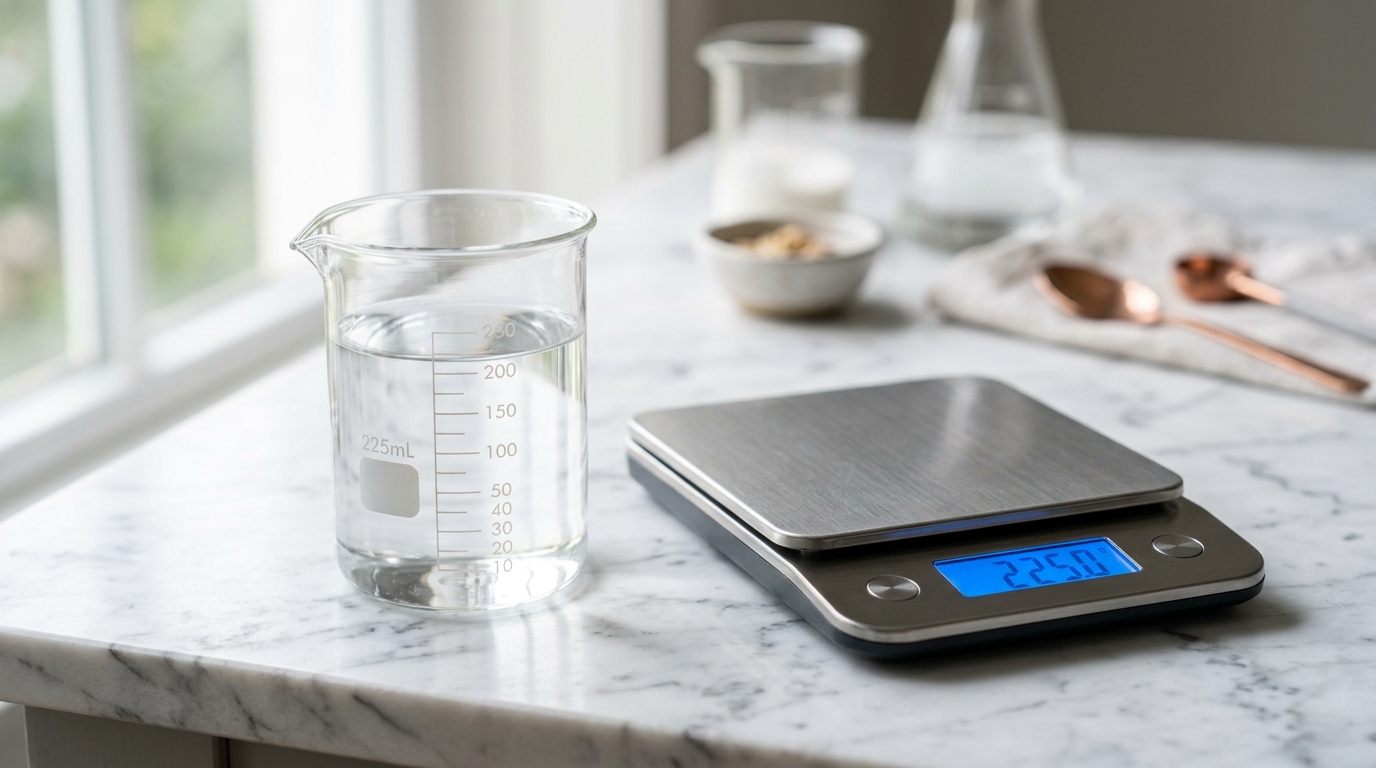
- Neglecting Container Tare: Always zero out the container on the scale before weighing liquids.
- Rounding Too Early: Keep decimal precision until the final result to avoid compounding rounding errors.
Frequently Asked Questions
How many pounds is 1 mL?
For water, 1 mL is approximately 0.002205 lb (or $0.0353\text{ oz}$). For other substances, multiply 0.002205 by the substance’s density in g/mL.
How much does 500 mL of water weigh?
Five hundred milliliters of water weighs 500 grams, which equals 1.102 pounds or 1 lb 1.64 oz.
How much does 1,000 mL weigh?
One thousand milliliters (1 liter) of water weighs 2.205 pounds or 2 lb 3.27 oz.
Can I convert mL to oz without density?
You can convert mL to fluid ounces without density because both measure volume. You cannot convert mL to weight ounces without knowing density or weighing the ingredient directly.